
Sandra Ann’s: Elijah & Elisha (sons of the prophets)
Sandra Ann’s: Elijah & Elisha
(sons of the prophets)
PDF of this post available for download or printing:
Sandra Ann on Facebook:
_________________________________________
March 8, 2026
Per the Lord’s leading, he has asked of me to share this post by Sandra Ann, from Facebook. It is quite a long post— as like mine with him are; and so he has asked for me to copy it as it is on her Facebook posting, but to put it into blog format— for it all runs together with no paragraph breaks, hardly, on Facebook. As well, when she finished the part about the prophets— it duplicated what was previously written— and two copies of the Elijah and Elisha story were printed on her Facebook post. Simply— the Lord has asked me to have it copied here for easier reading— and to make it available in PDF format for download and printing purposes.
This post explains Elijah’s mantle, Elisha’s mantle— the differences walked out by the same Spirit of the living God— but unto different purposes. And for myself— explains to me much more why he said to me, “You will help to mother my nation, Janet.”
I hope this blesses you, enlightens you, and encourages you to speak with the Lord about all of it: for truly— upon dealing with the powers of darkness (deliverance) —it is ‘healing’ that is upon the heart of our Father, of those who have come out of Egypt and Babylon (so to speak). As well— it has given me more insight into what ‘sons’ are in general… And what the Lord is looking for ‘discipled’ ones (raised up, taught, matured— ones, under even him).
And I thank you, in our Lord, Miss Sandra Ann, for this incredibly beautiful work you have accomplished with and by his Spirit.
_______________________________________
Sandra Ann’s post
Elijah & Elisha
_______________________________________
Mantle of Elijah:
Remember that Elijah had fled from Jezebel to Mount Sinai, and in a cave as he waited to hear the voice of God and there was thunder, earthquake and hail and lightning, and God wasn’t in all the noise and the hurricane. And then, in the utter stillness, there came the voice of a gentle blowing. Your old versions say, a ‘still, small voice.’ That was the voice of God, as if to say, “Elijah, you have been my lightning, you have been my tornado, and you have confronted the king and the queen of Israel, and you have brought down the Baal worship, and you smashed the powers of darkness. But now my people need healing, and I want you to go and anoint Elisha to take your place. Elisha will be that still, small voice. He will be the sound of a gentle blowing. He’ll not be a tornado, he’ll not be an earthquake, and he’ll not be a thunderstorm. He will mend my people. You had to smash Baal; now they have got to be healed in the stillness.”
The voice of God can be like a hurricane. The action of God can be like a thunderstorm. At other times, you need His gentleness to heal you, and that was the time Israel was in. They now needed someone to pick up the broken pieces of a people who hardly knew what they believed anymore, and put them back together. Elijah tore down the powers that kept Israel captive; Elisha was the compassionate heart of God demonstrated in his miracles of the Ax head, turning the bitter waters into sweet water, the Shunammite woman that was barren and bringing her son from the dead and the miracle of the oil in the jar.
So, the Lord said to Elijah, “You go now and here is his address. Go and anoint him, and he will be my next man here in Israel.”
Elisha was far to the North —just underneath the Lake of Galilee. He was part owner with his parents of a quite a large farm. They have twelve oxen plowing all at the same time across the strips. That’s a big farm! And so, you could say that in his day he was a wealthy farmer, a man who had suffered great persecution because he worshiped God when everyone else was worshiping Baal. Probably they wouldn’t buy his stuff at the market, but God knew his name and address. He knew his face.
And so Elijah comes. I’ve often tried to picture Elijah. What a character Elijah was! We’re not talking about Elijah right now, but do you remember I said that I wouldn’t like to meet Elijah on a dark night. He was unpredictable. He hadn’t seen a hairdresser in years! His hair was awry, his beard was awry, and he had this coat around him that looked the same as his beard and hair. It was this animal skin around him. He was a man that you never knew what he was going to say or do next! A fearless man who could stand in front of kings and tell them the curses that would come on them because of their immorality, etc. He riveted your attention. I’ve got a feeling that his eyes were just dark spots inside the hair that just held you. He comes pacing across the farm. He’s got a mission, and when they saw him, everyone knew who he was! He was the one who stood up to the king. He comes to the farm of Elisha and starts pacing across the field, dodging between the plows and the oxen until he comes to Elisha who is holding the twelfth plow. He takes off his coat and he flings it at Elisha so that it comes over him like a tent.
The Hebrew word for ‘spirit’ means air in motion, that is an invisible force that is moving. So, it means ‘wind,’ but it also means ‘breath.’ So, they understood it as the very breath and life of God in motion, in your life and around you, behind you, and ahead of you. The first mention of the word is in Genesis 1:1 where the spirit (same word) of God moved on the face of the waters.
That’s a beautiful picture in the Hebrew language because in the Hebrew it says, “And the spirit of God fluttered…” It means a bird that puts its wings up and down over the top of the eggs in the nest so that the eggs are hatched. That’s moving air, that is life.
And so, God had spoken the creative word, and the spirit of God is the life energy of creation. That is how they understood it. He is the life giver. He is the energizer. He is the doer and the bringer and the achiever of the Love purposes of God. Spirit – It means the infinitely active, invisible, personal presence of the Living God.
Elisha had seen that in the life of Elijah. If you didn’t know what it was, you would say, “There is something about that man!” You bet there is! There is some ONE about him that goes ahead of him, is inside of him, and comes up behind him! When he speaks, there is a divine energy in his words. The Spirit was upon and in Elijah. This Spirit gives wisdom and causes you to see what you hadn’t seen before. It gives you insight into the will of God.
Of course, preeminently, the Spirit, the actual moving presence of God, is power to bring His will to pass. When you know you have that, it comes with authority. So you are able to stand before Ahab and say, “According to my word this… and according to my word that…” You know because the Spirit is there!
Now, that might sound strange to us, but everybody knew what that meant in the Old Testament days. It was a two-fold symbolic action. The first thing was, Elijah was saying, “I am adopting you as my son.” That’s what you did. You took your coat and you put it over the child you were adopting. It is saying, “I’ll be your protection. I’ll be your umbrella, and under my protection, I will provide and care for you.” In this case, he was saying, ‘I will teach you. You will be my son and I will be your father. You, submitted to me, will learn what God has called you to do.’
Everybody knew that when a prophet took off that symbol (the cape) of his being a prophet and threw it over something, then that meant I am giving to you my office. You are going to be my successor.
So, this was two-fold: I am adopting you as my son. You shall now be my kin and I will teach you as I protect you and provide for you as you step into my shoes.
Elisha was a man with a faith that never bent, a man who had faced up to the Baal’s and had come through triumphant. He doesn’t blink when Elijah does this. He just says, “Let me just say goodbye to my old parents. That’s all I ask.” And Elijah says, “I don’t care. God called you – I didn’t! So go and do whatever you have to do.” And Elisha goes and kills the oxen and he does it in a correct fashion (that is, he makes a sacrifice). It was as if he was saying, “This is the end of my life. I take all of me now and I sacrifice it to God for Him to use as He will.”
And then he took the plow. That was his livelihood. He chopped it up and made a fire and he boiled the oxen on top of the fire and made a great sacrificial feast. It was a holy feast for all the extended to come and eat and bid their goodbye’s and realize that we are eating the sacrifice of God. We have entered into the giving of this person to the Lord. He says goodbye. He’ll never be back. He has literally burned his bridges behind him.
He goes. It says that he washed the hands of Elijah. When we work it out, for about eight years Elisha did nothing except serve Elijah, which is what is meant by the Hebrew term ‘he washed his hands.’ And so Elijah provided and Elisha cooked. If they had any sort of hut to live in, Elisha swept it out. Elisha was the servant for eight years. Good grief! I thought he would have a ministry by the end of six months. But, for eight years he listens to this man. Very few people had. If you follow Elijah, you see that he was never around. He was here today, gone tomorrow. Nobody knew where he was. He didn’t talk to people. He didn’t like people. He’s a hermit in the best sense of the word, a man from the hills who loved the hills and hated people. To have him to yourself for eight years as Elijah taught Elisha what it is to wait on God, what it is to hear the voice of God, and what is faith that you can stand before an Ahab and say, ‘It shall not rain again according to my word,’ and to go back to Ahab years later and say, ‘At my word it shall rain again.’ I mean, where do you get that from?
Eight years Elijah teaches Elisha. No one knows Elisha. If anybody knows anybody, they know Elijah. Who is that kid with him? I don’t know…
I say that because we live in a day of instant everything! There’s no instant everything. It takes time to grow in God; it takes time to learn the ways of God. Elisha was humble enough to wash the hands of Elijah and learn the ways of the prophet.
There were those who were called the ‘sons of the prophets.’ They go back hundreds of years from this point in history. Samuel the prophet was the first one to establish this office. I suppose today you would call them bible schools, but most of the bible schools I have gone to wouldn’t fit the bill because they are students in the bible schools today. The Old Testament doesn’t know that. I’m sorry that some of you may think I am pushing this too much, but our mode of education today is totally the opposite of what is in the Scripture. We cram our heads and think we know something. I have spoken in bible schools in this country, and they are run the same way as the public school. They have exams at the end. You can’t take an exam about God! You can’t get an A on the Holy Spirit! If you don’t know Him, God save you from knowing ABOUT Him! Do you follow?
This was not a school in the sense that we understand here in the West. Did you notice that they are not students of prophecy? They are sons of the prophets. That’s a big word and it is going to come up. The Sons of the Prophet… That is, Elijah was looked upon as their spiritual father, not as the lecturer. He was the one that built truth into them, who modeled truth in front of them like a father to his children. It was a relational teaching. It was, “This is what is my heart, and I am going to hang out with you until you get it!” It’s a family thing.
They were sons, and, of course, sons in the sense of scripture, which means that you are submitted to the father. It means you do what he says, and you don’t always understand why he said what he said, but you do it because you are a child in the family. That is here.
And so, the sons of the prophets were communities. Some of the communities were large, in one place we read that there were a hundred of them living all in the same area, in this relational attitude to Elijah and then to Elisha. Another time we read that there were fifty of them. Sometimes the communities were very small, but they were scattered throughout the area.
Now, sons of the prophets…. That is, from the prophets since Samuel. Right now, it is Elijah. Sons! Well, what did Elijah just do to Elisha? He said, “I adopt you as my son.” So, there is one sense at this point that Elisha is one of the sons of the prophets, but he has been adopted in a unique way, because these other men had never had the cloak of Elijah thrown on them, and so he knows he has been called for a unique job.
Incidentally, tradition tells us that the prophet Jonah was one of the sons of the prophets who Elijah taught, and he later became who he was.
There are a lot of them, and some of them went on to have great impact; others didn’t. But, Elisha is a son of the prophet, but he has been called to that and he has a relationship to Elijah that the others don’t. So, for eight years… essentially we don’t know what happened, except he just hung out with Elijah wherever Elijah was, served him, listened, learned, submitted. After eight years, Elijah knows the end is drawing near, and Elisha knew it, too. How? We don’t know, but he did know it.
That’s when that little thing began of Elijah telling Elisha, “Now you stay here because I have a special mission in Bethel.” And, Elisha says, “I’m not leaving you! You can’t get rid of me like that.” He stuck with him.
What’s Elijah doing? I think the truth is that Elijah didn’t like people, and he wants to be alone. Especially since Elijah knows that he is going to be caught up in a very wonderful way into the presence of God. He knows that, and for whatever reason, he appears not to want anyone to see that. This is a private, intimate event between him and God. I also wonder whether he was putting Elisha off in order to bring out the most focused desire in Elisha: “You won’t put me off! I’m coming with you!”
When they get to Bethel, he says, “Now you stay here with the sons of the prophets. I’m going on to the next community of the sons of the prophets in Jericho.” Again, Elisha says, “No, I’m coming with you.” Every time that they got to the sons of the prophets in Bethel and Jericho, they all gathered around Elisha and they said, “Don’t you know your master is going to leave? He’s going to be taken from you.” Elisha says, “I know it! Shut up! I know it! I’m not leaving him. If he goes, I am going to see him go.”
And then, they come down to the River Jordan.
That’s where the sons of the prophets went, and they stood on that hill. They could watch as these two went on. Elijah and Elisha come to the River Jordan, and Elijah takes off that hairy coat and wraps it around until it is tight like a staff. And then, he slams it down on top of the River Jordan and immediately the River Jordan is opened for them, the same as the Red Sea had opened before Moses, and the same River Jordan that opened before Joshua. They go across on dry land.
The sons of the prophets have seen that. As they come up the other side, Elijah turns to Elisha and says, “Well, I’m about to go. I’d like to give you something before I leave. Ask whatever you want.” And, Elisha doesn’t blink! He says, “That I might have a double portion of your spirit.”
Double portion— is an expression that is taken from the Law of Moses. It’s all through the Bible. In simple terms, in a family where the father is dying, the question is, “How is he going to divide his inheritance?” Well, the Law of Moses said that he took the firstborn son, and he gives to that firstborn son a double portion. The firstborn son gets double of whatever everyone else gets. Whatever is left over is divided among the others. He gets double because he is now going to become chief of the clan. He’s going to step into his father’s shoes, and he’s going to be the lord of the family. That is the meaning of a double portion.
What is Elisha saying?
He is saying ‘Look at all these sons you’ve got. There could be hundreds of them! They are all officially called sons of the prophet. If I am going to step into your shoes, if I am going to continue your work, if I am going to confront a Baal-infested world and heal it, then I need the firstborn’s inheritance. I need to be your heir. I need your spirit to rest upon me in the same way that I can become a father to all of Israel, and a father to these sons of the prophets. They will have your spirit divided among them all, but I need the firstborn’s inheritance.’
Do you understand what that is saying? He is facing the Baal’s, the terrible demonic power that had held Israel. It’s that demon god of materialism and pornography that is still with us today under different guises. Baal and Asherah, the dual god and goddess that controlled the minds and passions of Israel – Elijah had broken it, but Elisha says, “How can I now go and face the same powers without the empowering of the same spirit and the spirit upon me that will make me an heir of all your ministry and will enable me to step into your shoes? Give me the same spirit.”
Now, they didn’t understand the Holy Spirit the same way as we do today, but the word ‘spirit’ has plenty of meaning in the Old Testament.
Elijah and Elisha have been the Bethel in the mountains, and they come down to Jericho. Over here is the River Jordan. All the way down to Jericho, Elijah has said to Elisha, “Would you please go away. I’ve got a private errand to do.” Elisha’s response has been, “Not on your life! I’m not leaving you!”
And so, they come from Bethel, and when he comes to Jericho, he (Elijah) said, “Would you stay here because I’ve got a private mission down at the Jordan.” And Elisha says, “Nothing doing, Buddy! I’m coming with you!”
That’s the background.
And so, they are now going to the River Jordan. 2 Kings 2:7:
Now fifty men of the sons of the prophets went and stood opposite them at a distance while the two of them (Elijah and Elisha) stood by the Jordan. Elijah took his mantle…
[A mantle was a cape made of some animal skin. It was hairy, and it was the badge or the mark of a prophet. It was almost the same as this collar around my neck, in that it let people know, “There is a prophet.” It was the mark or a prophet, the authority that went with it, and hopefully, the power of God that went with it, too. And so, he had this cape around him that served as a blanket on cold nights, and he sort of lived with it…]
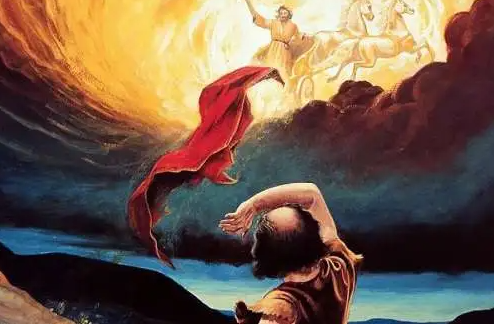
…(He) took his mantle, folded it together and struck the waters of the Jordan, and they divided, here and there so that the two of them crossed over on dry ground. When they had crossed over, Elijah said to Elisha, ‘Ask what I shall do for you before I am taken from you.’ And, Elisha said, ‘Please let a double portion of your spirit be upon me.’ And Elijah said, ‘You have asked a hard thing. Nevertheless, if you see me when I am taken from you, it shall be so for you. But if not, it shall not be so.’ As they were going along and talking, behold! There appeared a chariot of fire and horses of fire which separated the two of them and Elijah went up with a whirlwind to heaven. Elisha saw it and cried out, ‘My father! My father! The chariots of Israel and its horsemen.’ And he saw Elijah no more. Then he took hold of his own clothes and tore them in two pieces. He also took up the mantle of Elijah that fell from him and returned and stood by the bank of the Jordan. He took the mantle of Elijah that fell from him and struck the waters and said, ‘Where is the Lord the God of Elijah?’ And when he also had struck the waters, they were divided here and there. And Elisha crossed over.
________________
Prophets were the immediate organs of God for the communication of his mind and will to men (Deut. 18:18-19). The whole Word of God, may in this general sense, be spoken of as prophetic, inasmuch as it was written by men who received the revelation they communicated from God, no matter what its nature might be. The foretelling of future events was not ‘a necessary,’ but only an incidental, part of the prophetic office. The great task assigned to the prophets whom God raised up among the people was “to correct moral and religious abuses, to proclaim the great moral and religious truths which are connected with the character of God, and which lie at the foundation of his government.”
The seventy elders of Israel (Num. 11:16-29), “when the spirit rested upon them, prophesied;” Asaph and Jeduthun Any one being a spokesman for God to man might thus be called a prophet. Thus Enoch, Abraham, and the patriarchs, as bearers of God's message (Gen. 20:7; Ex. 7:1; Ps. 105:15), as also Moses (Deut. 18:15;34:10; Hos. 12:13), are ranked among the prophets.
“Prophesied with a harp” (1 Chr. 25:3). Miriam and Deborah were prophetesses (Ex. 15:20; Judg. 4:4). The title thus has a general application to all who have messages from God to men.
But while the prophetic gift was thus exercised from the beginning, the prophetical order as such began with Samuel. Colleges, “schools of the prophets”, were instituted for the training of prophets, who were constituted, a distinct order (1 Sam. 19:18-24; 2 Kings 2:3, 15; 4:38), which continued to the close of the Old Testament. Such “schools” were established at Ramah, Bethel, Gilgal, Gibeah, and Jericho.
The “sons” or “disciples” of the prophets were young men (2 Kings 5:22; 9:1, 4) who lived together at these different “schools” (4:38-41). These young men were taught not only the rudiments of secular knowledge, but they were brought up to exercise the office of prophet, “to preach pure morality and the heart-felt worship of Jehovah, and to act along and co-ordinately with the priesthood and monarchy in guiding the state aright and checking all attempts at illegality and tyranny.”
In New Testament times the prophetical office was continued. Our Lord is frequently spoken of as a prophet (Luke 13:33; 24:19). He was and is the great Prophet of the Church. There was also in the Church a distinct order of prophets (1 Cor. 12:28; Eph. 2:20; 3:5), who made new revelations from God. They differed from the “teacher,” whose office it was to impart truths already revealed.
Of the major Old Testament prophets there are sixteen, whose prophecies form part of the inspired canon.
______________________________________
End of post by Sandra Ann.


Comments